The Brehons
From A Smaller Social History of Ancient Ireland 1906
« previous page | contents | next page »
CHAPTER IV.
THE BREHON LAWS
SECTION 1. The Brehons.
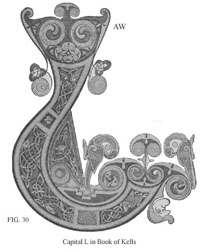 formed a most important factor both in public and private life in ancient Ireland. The native legal system, as briefly outlined in this chapter, existed in its fulness before the ninth century. It was somewhat disturbed by the Danish and Anglo-Norman invasions, and still more by the English settlement; but it continued in use till finally abolished in the beginning of the seventeenth century. In this short chapter I merely attempt a popular sketch of the main features of the Brehon laws, devoid of technical legal terms.
In Ireland a judge was called a brehon, whence the native Irish law is commonly known as the "Brehon Law": but its proper designation is Fénechas, i.e. the law of the Féine or Féne, or free land-tillers. The brehons had absolutely in their hands the interpretation of the laws and the application of them to individual cases. They were therefore a very influential class of men; and those attached to chiefs had free lands for their maintenance, which, like the profession itself, remained in the same family for generations. Those not so attached lived simply on the fees of their profession, and many eminent brehons became wealthy. The legal rules, as set forth in the Law Books, were commonly very complicated and mixed up with a variety of technical terms; and many forms had to be gone through and many circumstances taken into account, all legally essential: so that no outsider could hope to master their intricacies. The brehon had to be very careful; for he was himself liable for damages, besides forfeiting his fee, if he delivered a false or an unjust judgment.
To become a brehon a person had to go through a regular, well-defined course of study and training. It would appear that the same course qualified for any branch of the legal profession, and that once a man had mastered the course, he might set up as a brehon or judge proper, a consulting lawyer, an advocate, or a law-agent. In very early times the brehon was regarded as a mysterious, half-inspired person, and a divine power kept watch over his pronouncements to punish him for unjust judgments:—"When the brehons deviated from the truth, there appeared blotches upon their cheeks." The great brehon, Morann, son of Carbery Kinncat (king of Ireland in the first century), wore a sín [sheen] or collar round his neck, which tightened when he delivered a false judgment, and expanded again when he delivered the true one. All this agrees with the whole tenor of Irish literature, whether legendary, legal, or historical, which shows the great respect the Irish entertained for justice pure and simple according to law, and their horror of unjust decisions. It was the same at the most ancient period as it was in the beginning of the seventeenth century, when Sir John Davies—an Englishman—the Irish attorney-general of James I., testified:—"For there is no nation of people under the sunne that doth love equall and indifferent [i.e. impartial] justice better then the Irish; or will rest better satisfied with the execution thereof, although it bee against themselves: so as they may have the protection and benefit of the law, when uppon just cause they do desire it." But later on the Penal Laws changed all that, and turned the Irish natural love of justice into hatred and distrust of law, which in many ways continues to manifest itself to this day.