
The Senchus Mor
From A Smaller Social History of Ancient Ireland 1906
« previous page | contents | start of chapter | next page »
CHAPTER IV....continued
2. The Senchus Mór and other Books of Law.
The brehons had collections of laws in volumes or tracts, all in the Irish language, by which they regulated their judgments, and which those of them who kept law-schools expounded to their scholars; each tract treating of one subject or one group of subjects. Many of these have been preserved, and of late years the most important have been published, with translations, forming five printed volumes (with a sixth consisting of a valuable Glossary to the preceding five). Of the tracts contained in these volumes, the two largest and most important are the Senchus Mór [Shanahus More] and the Book of Acaill [Ack'ill].
In the ancient Introduction to the Senchus Mór the following account is given of its original compilation. In the year 438 A.D. a collection of the pagan laws was made at the request of St. Patrick; and Laegaire [Laery], king of Ireland, appointed a committee of nine learned and eminent persons, including himself and St. Patrick, to revise them. At the end of three years these nine produced a new code, from which everything that clashed with the Christian doctrine had been carefully excluded. This was the Senchus Mór.
The very book left by St. Patrick and the others has been long lost. Successive copies were made from time to time, with commentaries and explanations appended, till the manuscripts we now possess were produced. The existing manuscript copies of the Senchus Mor consist of:—1. The original text, written in a large hand with wide spaces between the lines: 2. An introduction to the text: 3. Commentaries on the text, in a smaller hand: 4. Glosses or explanations on words and phrases of the text, in a hand still smaller: commentaries and glosses commonly written in the spaces between the lines of the text, but often on the margins.
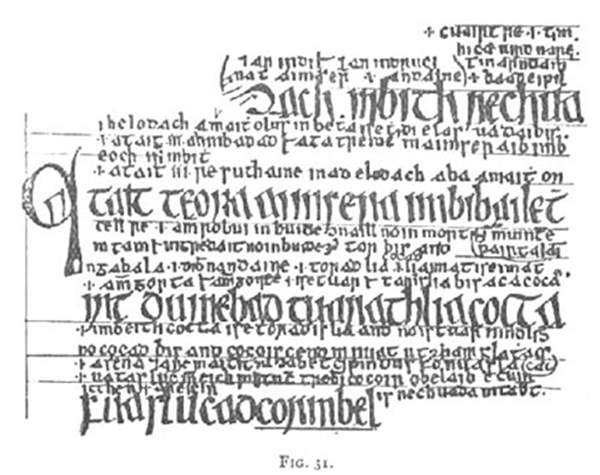
FIG. 31. Facsimile specimen of the Senchus Mor. The four lines of large text are a part of the Senchus Mor proper; and they are to be read in the order, second, first, third, fourth. The commentary (i.e. the small text) consists of seventeen lines and, supposing them to be numbered from top to bottom, they are to be read in this way—Begin at line 8 (which comments on the line of larger text right under it), then 7, 6, 5; part of 4 and part of 3 (both as far as the curve; the rest of 4, the rest of 3, then 2, 1. Resume at 9 and go on in like manner—sometimes upwards, sometimes downwards—to the end: the reader being guided all through by the context. No glosses occur on this facsimile.
Of these the text, as might be expected, is the most ancient.
The laws were written in the oldest dialect of the Irish language, called Bérla Féini [Bairla-faina], which even at the time was so difficult that persons about to become brehons had to be specially instructed in it. Even the authors of the Commentaries and Glosses who wrote hundreds of years ago, and were themselves learned brehons, were often quite at fault in their attempts to explain the archaic text: and their words show that they were fully conscious of the difficulty. It will then be readily understood that the task of translating these laws was a very difficult one, rendered all the more so by the number of technical terms and phrases, many of which are to this day obscure, as well as by the peculiar style, which is very elliptical and abrupt—often incomplete sentences, or mere catch-words of rules not written down in full, but held in memory by the experts of the time. Another circumstance that greatly adds to the difficulty of deciphering these MSS. is the confused way in which the Commentaries and glosses are written in, mainly with the object of economising the expensive vellum. The explanatory note under fig. 31 will give some idea of this.
The two great Irish scholars—O'Donovan and O'Curry—who translated the Laws included in the five printed volumes, were able to do so only after a life-long study; and in numerous instances were, to the last, not quite sure of the meaning. As they had to retain the legal terms and the elliptical style, even the translation is hard enough to understand, and is often unintelligible. It is, moreover, imperfect for another reason: it was only a preliminary and provisional translation, containing many imperfections and errors, to be afterwards corrected; but the translators did not live to revise it, and it was printed as they left it.