Historic Tales
The second source of historical information may be found in the Historic Tales. The reciting of historic tales was one of the principal duties of the Ollamh, and he was bound to preserve the truth of history "pure and unbroken to succeeding generations."
"According to several of the most ancient authorities, the Ollamh, or perfect Doctor, was bound to have (for recital at the public feasts and assemblies) at least Seven Fifties of these Historic narratives; and there appear to have been various degrees in the ranks of the poets, as they progressed in education towards the final degree, each of which was bound to be supplied with at least a certain number. Thus the Anroth, next in rank to an Ollamh, should have half the number of an Ollamh ;the Cli, one-third the number, according to some authorities, and eighty according to others; and so on down to the Fochlog, who should have thirty; and the Driseg (the lowest of all), who should have twenty of these tales."[7]
The Ollamhs. like the druids or learned men of other nations, were in the habit of teaching the facts of history to their pupils in verse,[8] probably that they might be more easily remembered.
A few of these tales have been published lately, such as the Battle of Magh Bath, the Battle of Muighe Leana, and the Tochmarc Momera. Besides the tales of Battles (Catha), there are the tales of Longasa, or Voyages; the tales of Tóghla, or Destructions; of Slaughters, of Sieges, of Tragedies, of Voyages, and, not least memorable, of the Tána, or Cattle Spoils, and the Tochmarca, or Courtships. It should be remembered that numbers of these tales are in existence, offering historical materials of the highest value. The Books of Laws demand a special and more detailed notice, as well as the Historical Monuments. With a brief mention of the Imaginative Tales and Poems, we must conclude this portion of our subject.
Ancient writings, even of pure fiction, must always form an important historical element to the nation by which they have been produced. Unless they are founded on fact, so far as customs, localities, and mode of life are concerned, they would possess no interest; and their principal object is to interest. Without some degree of poetic improbabilities as to events, they could scarcely amuse; and their object is also to amuse. Hence, the element of truth is easily separated from the element of fiction, and each is available in its measure for historic research. The most ancient of this class of writings are the Fenian Poems and Tales, ascribed to Finn Mac Cumhaill, to his sons, Oisin and Fergus Finnbheoill (the Eloquent), and to his kinsman, Caeilite. There are also many tales and poems of more recent date. Mr. O'Curry estimates, that if all MSS. known to be in existence, and composed before the year 1000, were published, they would form at least 8,000 printed pages of the same size as O'Donovan's Annals of the Four Masters.
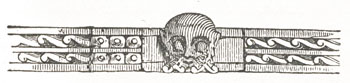
From Sculptures at Devenish
Notes
[7] Tales.—O'Curry, p. 241.
[8] Verse.—See Niebuhr, Hist. vol. i. pp. 254-261. Arnold has adopted his theory, and Macaulay has acted on it. But the Roman poems were merely recited at public entertainments, and were by no means a national arrangement for the preservation of history, such as existed anciently in Ireland. These verses were sung by boys more patrum (Od. iv. 15), for the entertainment of guests. Ennius, who composed his Annales in hexameter verse, introducing, for the first time, the Greek metre into Roman literature, mentions the verses which the Fauns, or religious poets, used to chant. Scaliger thinks that the Fauns were a class of men who exercised in Latium, at a very remote period, the same functions as the Magians in Persia and the Bards in Gaul. Niebuhr supposes that the entire history of the Roman kings was formed from poems into a prose narrative.