Milesians in Ireland

From An Illustrated History of Ireland by Margaret Anne Cusack

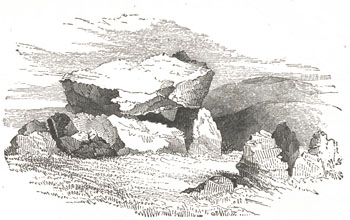
Cromlech at Dunmore, Waterford

Cromlech at Dunmore

Chapter V.

« Social State of Ancient Ireland | Contents | Index | Traditions »

Landing of the Milesians—Traditions of the Tuatha De Dananns in St. Patrick's time—The Lia Fail, or Stone of Destiny—The Milesians go back to sea "nine waves "—They conquer ultimately—Reign of Eremon—Landing of the Picts—Bede's Account of Ireland—Fame of its Fish and Goats—Difficulties of Irish Chronology—Importance and Authenticity of Irish Pedigrees—Qualifications of an Ollamh—Milesian Genealogies—Historical Value of Pedigrees—National Feelings should be respected—Historic Tales—Poems.

[A.M. 3500.]
Letter T

HE last colonization of Ireland is thus related in the Annals of the Four Masters: "The age of the world 3500. The fleet of the sons of Milidh came to Ireland at the end of this year, to take it from the Tuatha Dé Dananns, and they fought the battle of Sliabh Mis with them on the third day after landing. In this battle fell Scota, the daughter of Pharaoh, wife of Milidh; and the grave of Scota [3] is [to be seen] between Sliabh Mis and the sea. Therein also fell Fas, the wife of Un, son of Uige, from whom is [named] Gleann Faisi. After this the sons of Milidh fought a battle at Taillten [4] against the three kings of the Tuatha Dé Dananns, MacCuill, MacCeacht, and MacGriéné. The battle lasted for a long time, until MacCeacht fell by Eiremhon, MacCuill by Eimheur, and MacGriéné by Amhergen."[5] Thus the Tuatha Dé Danann dynasty passed away, but not without leaving many a quaint legend of magic and mystery, and many an impress of its more than ordinary skill in such arts as were then indications of national superiority. The real names of the last chiefs of this line, are said to have been respectively Ethur, Cethur, and Fethur. The first was called MacCuill, because he worshipped the hazel-tree, and, more probably, because he was devoted to some branch of literature which it symbolized; the second MacCeacht, because he worshipped the plough, i.e., was devoted to agriculture; and the third obtained his appellation of MacGriene because he worshipped the sun.

« Social State of Ancient Ireland | Contents | Index | Traditions »


[3] Scota.—The grave is still pointed out in the valley of Gleann Scoithin, county Kerry.

[4] Taillten —Now Telltown, county Meath.

[5] Amhergen.—Annals of the Four Masters, vol. i. p. 25.

FEATURED eBOOKS

Truelove's Journal: A Bookshop Novella

From a sad, comfortless childhood Giles Truelove developed into a reclusive and uncommunicative man whose sole passion was books. For so long they were the only meaning to his existence. But when fate eventually intervened to have the outside world intrude upon his life, he began to discover emotions that he never knew he had.

A story for the genuine booklover, penned by an Irish bookseller under the pseudonym of Ralph St. John Featherstonehaugh.

FREE download 23rd - 27th May

Annals of the Famine in Ireland

Annals of the Famine in Ireland

Annals of the Famine in Ireland, by Asenath Nicholson, still has the power to shock and sadden even though the events described are ever-receding further into the past. When you read, for example, of the poor widowed mother who was caught trying to salvage a few potatoes from her landlord's field, and what the magistrate discovered in the pot in her cabin, you cannot help but be appalled and distressed.

The ebook is available for download in .mobi (Kindle), .epub (iBooks, etc.) and .pdf formats. For further information on the book and author see details ».

Ireland's Welcome to the Stranger

Ireland's Welcome to the Stranger

This book, the prequel to Annals of the Famine in Ireland cannot be recommended highly enough to those interested in Irish social history. The author, Mrs Asenath Nicholson, travelled from her native America to assess the condition of the poor in Ireland during the mid 1840s. Refusing the luxury of hotels and first class travel, she stayed at a variety of lodging-houses, and even in the crude cabins of the very poorest. Not to be missed!

The ebook is available for download in .mobi (Kindle), .epub (iBooks, etc.) and .pdf formats. For further information on the book and author see details ».

The Scotch-Irish in America

The Scotch-Irish in America

Henry Ford Jones' book, first published in 1915 by Princeton University, is a classic in its field. It covers the history of the Scotch-Irish from the first settlement in Ulster to the American Revolutionary period and the foundation of the country.

The ebook is available for download in .mobi (Kindle), .epub (iBooks, etc.) and .pdf formats. For further information on the book and author see details ».

MAILING LIST

letterJoin our mailing list to receive updates on new content on Library, our latest ebooks, and more.

You won't be inundated with emails! — we'll just keep you posted periodically — about once a monthish — on what's happening with the library.