Hanlon's Mill - Fairy Legends of Ireland
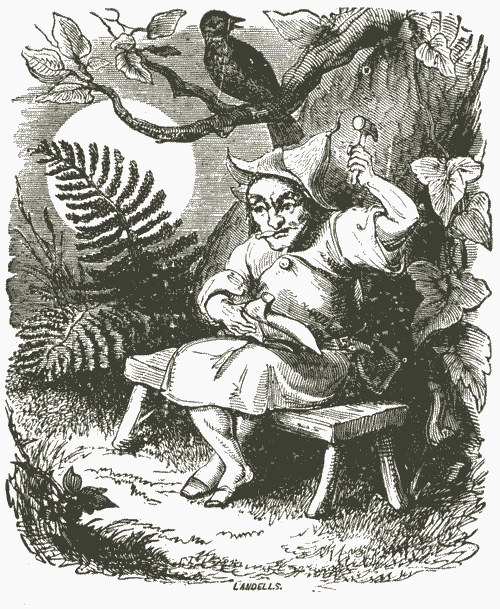
NE fine summer's evening Michael Noonan went over to Jack Brien's, the shoemaker, at Ballyduff, for the pair of brogues which Jack was mending for him. It was a pretty walk the way he took, but very lonesome; all along by the riverside, down by the oakwood, till he came to Hanlon's mill, that used to be, but that had gone to ruin many a long year ago.
Melancholy enough the walls of that same mill looked; the great old wheel black with age, all covered over with moss and ferns, and the bushes all hanging down about it. There it stood, silent and motionless: and a sad contrast it was to its former busy clack, with the stream which once gave it use rippling idly along.
Old Hanlon was a man that had great knowledge of all sorts; there was not a herb that grew in the field but he could tell the name of it and its use, out of a big book he had written, every word of it in the real Irish karacter. He kept a school once, and could teach the Latin; that surely is a blessed tongue all over the wide world; and I hear tell as how "the great Burke" went to school to him. Master Edmund lived up at the old house there, which was then in the family, and it was the Nagles that got it afterwards, but they sold it.
But it was Michael Noonan's walk I was speaking of. It was fairly between lights, the day was clean gone, and the moon was not yet up, when Mick was walking smartly across the Inch. Well, he heard, coming down out of the wood, such blowing of horns and hallooing, and the cry of all the hounds in the world, and he thought they were coming after him; and the galloping of the horses, and the voice of the whipper-in, and he shouting out just like the fine old song,—
"Hallo Piper, Lily, agus Finder;"
and the echo over from the grey rock across the river giving back every word as plainly as it was spoken. But nothing could Mick see, and the shouting and hallooing following him every step of the way till he got up to Jack Brien's door, and he was certain, too, he heard the clack of old Hanlon's mill, going through all the clatter. To be sure, he ran as fast as fear and his legs could carry him, and never once looked behind him, well knowing that the Duhallow hounds were out in quite another quarter that day, and that nothing good could come out of the noise of Hanlon's mill.
Well, Michael Noonan got his brogues, and well heeled they were, and well pleased was he with them; when who should be seated at Jack Brien's before him, but a gossip of his, one Darby Haynes, a mighty decent man, that had a horse and cart of his own, and that used to be travelling with it, taking loads like the Royal mail coach between Cork and Limerick; and when he was at home Darby was a near neighbour of Michael Noonan's.
"Is it home you're going with the brogues this blessed night?" said Darby to him.
"Where else would it be?" replied Mick; "but, by my word, 'tis not across the Inch back again I'm going, after all I heard coming here; 'tis no good that old Hanlon's mill is busy again."
"True, for you," said Darby; "and may be you'd take the horse and car home for me, Mick, by way of company, as 'tis along the road you go. I'm waiting here to see a sister's son of mine that I expect from Kilcoleman."
"That same I'll do," answered Mick, "with a thousand welcomes." So Mick drove the car fair and easy, knowing that the poor beast had come off a long journey; and Mick—God reward him for it!—was always tender-hearted and good to the dumb creatures.
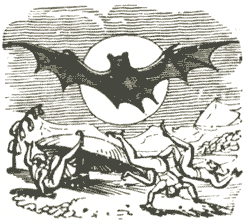
The night was a beautiful one; the moon was better than a quarter old; and Mick, looking up at her, could not help bestowing a blessing on her beautiful face, shining down so sweetly upon the gentle Awbeg. He had now got out of the open road, and had come to where the trees grew on each side of it: he proceeded for some space in the half-and-half light which the moon gave through them. At one time, when a big old tree got between him and the moon, it was so dark that he could hardly see the horse's head; then, as he passed on, the moonbeams would stream through the open boughs and variegate the road with lights and shades. Mick was lying down in the car at his ease, having got clear of the plantation, and was watching the bright piece of a moon in a little pool at the road-side, when he saw it disappear all of a sudden, as if a great cloud came over the sky. He turned round on his elbow to see if it was so, but how was Mick astonished at finding, close alongside of the car, a great high black coach drawn by six black horses, with long black tails reaching almost down to the ground, and a coachman dressed all in black sitting upon the box. But what surprised Mick the most was that he could see no sign of a head either upon coachman or horses. It swept rapidly by him, and he could perceive the horses raising their feet as if they were in a fine slinging trot, coachman touching them up with his long whip, and the wheels spinning round like hoddy-doddies; still he could hear no noise, only the regular step of his gossip Darby's horse, and the squeaking of the gudgeons of the car, that were as good as lost entirely for want of a little grease.
Poor Mick's heart almost died within him, Dut he said nothing, only looked on; and the black coach swept away, and was soon lost among some distant trees. Mick saw nothing more of it, or indeed of anything else. He got home just as the moon was going down behind Mount Hillery—took the tackling off the horse, turned the beast out in the field for the night, and got to his bed.
Next morning, early, he was standing at the road side thinking of all that had happened the night before, when he saw Dan Madden, that was Mr. Wrixon's huntsman, coming on the master's best horse down the hill, as hard as ever he went at the tail of the hounds. Mick's mind instantly misgave him that all was not right, so he stood out in the very middle of the road, and caught hold of Dan's bridle when he came up.
"Mick, dear—for the love of God! don't stop me," cried Dan.
"Why, what's the hurry?" said Mick.
"Oh, the master—he's off—he's off—he'll never cross a horse again till the day of judgment!"
"Why, what would ail his honour?" said Mick; "sure it is no later than yesterday morning that I was talking to him, and he stout and hearty; and says he to me, Mick, says he——"
"Stout and hearty was he?" answered Madden; "and was he not out with me in the kennel last night, when I was feeding the dogs? and didn't he come out to the stable, and give a ball to Peg Pullaway with his own hand, and tell me he'd ride the old General to-day; and sure," said Dan, wiping his eyes with the sleeve of his coat, "who'd have thought that the first thing I'd see this morning was the mistress standing at my bedside, and bidding me get up and ride off like fire for Doctor Johnson; for the master had got a fit, and"—poor Dan's grief choked his voice—"oh, Mick! if you have a heart in you, run over yourself, or send the gossoon for Kate Finnigan, the midwife; she's a cruel skilful woman, and may be she might save the master till I get the doctor."
Dan struck his spurs into the hunter, and Michael Noonan flung off his newly-mended brogues, and cut across the fields to Kate Finnigan's; but neither the doctor nor Katty was of any avail, and the next night's moon saw Ballygibblin—and more's the pity—a house of mourning.