Catalogue of the Orders of the Saints
This Catalogue is considered to be very important, and calls for some observations. Ussher was the first to publish a text of the “Catalogue of the Saints,” as he called it, and he had two texts before him, which date from before the end of the twelfth century. There are two other texts, one published by Fleming in his Collectanea, and the other is found in the Codex Salmanticensis, which are of a subsequent date. The author of the catalogue and its approximate date cannot be ascertained. It stops at 666, but the writer probably lived some centuries later. The statements contained in it should be carefully examined. It is said there were 350 bishops in the time of St. Patrick, and that they were all saints. It is certain they were not declared canonised at Rome, as only two Irish Saints, St. Laurence O’Toole and St. Malachy, have been canonised by a pontifical decree. We have no idea what steps were taken by the Irish Church before she pronounced her deceased children saints. The Universal Church demands a most searching inquiry before a servant of God is canonised, and such has always been the practice of the Church, except the case of martyrdom. There is scarcely a doubt that the Irish multiplied their saints unduly, which is proved from this catalogue, as also from the Litany of Aengus, composed about the year 800. This litany consists of groups of bishops, priests, monks, etc. With reference to this question the Bolandists remark:—
“The Irish would not have been so liberal in canonising in troops their dead, who had shown more than ordinary virtue, if they had observed the practice of the Universal Church, which conferred the honour only on martyrs. But as to those who had not been known to have won the prize of martyrdom, their lives were examined singly: their early, middle, and closing years, and the miracles that accompanied or followed, and, severally and singly, were added to the number of those who may be ritually invoked, either by Pontifical decree or by the common voice of a Christian people, induced by evident and frequent miracles, to form a sure belief in the ‘saintship’ of the individual.”
Read "The History of West Cork" at your leisure
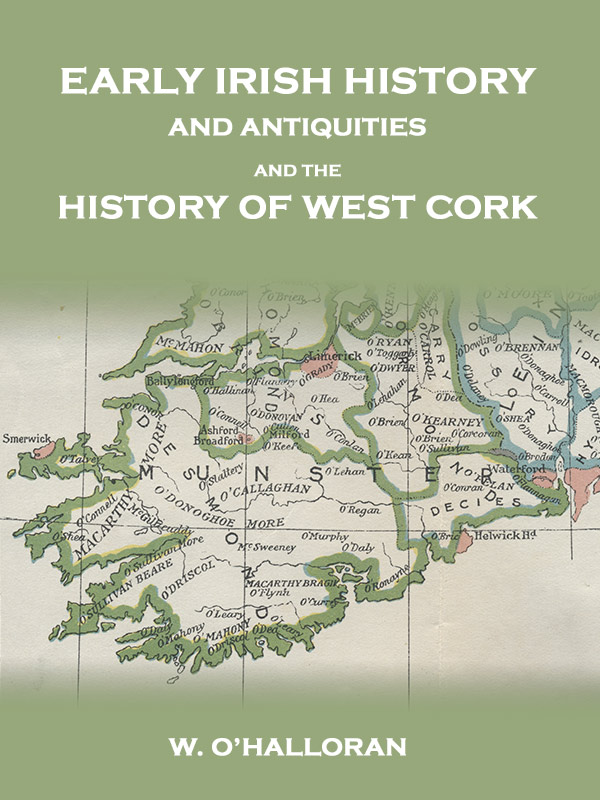
Read The History of West Cork at your leisure and help support this free Irish library.
Enjoy this book on just about any device of your choice. Full hyperlinked contents and index have been included to make navigation easy, and the experience pleasurable.
The ebook is available in .mobi (for Kindle), .epub (for iBooks, etc.), and .pdf formats. See details ».