
New York to Londonderry
AT New York, on the 26th of June, we boarded the SS. Columbia, the new twin-screw steamer of the Anchor Line. Every berth was taken, and as the passengers were a bright set, "on pleasure bent," there was an entire absence of formality and exclusiveness. They sang, danced, and amused themselves in many original ways, while the Columbia reeled off the knots with a clock-like regularity very agreeable to the experienced travellers on board.
As our destination was Londonderry, we took a northerly course, which brought us into floating ice-fields and among schools of porpoises and whales; in fact, it was an uneventful day on which some passenger could not boast of having seen "a spouter, just a few minutes ago!"
We celebrated the morning of the Fourth of July in a very pretentious way with a procession of the nations in costume and burlesques on the conditions of the day. The writer was cast to represent the Beef Trust, and at two hundred and twenty-five pounds the selection met with popular approval; but he found a passenger of thirty-five pounds more in the foreground, and thereupon retired to the side-lines. Attorney Grant, of New York, made a striking "Rob Roy," with his colossal Corinthian pillars in their natural condition. A long list of games and a variety of races for prizes gave us a lively afternoon, and the evening wound up with a "grand " concert, at which Professor Green, of Yale, made an excellent comic oration.
W. A. Ross, of New York, was my companion on the trip; A. B. Hepburn, ex-Comptroller of the Currency, intended going with us, but was prevented at the last moment by a pressure of business, which we very much regretted.
The steamer soon sighted Tory Island, rapidly passed Malin Head, and then turned in to Lough Foyle. When a few miles inside the mouth of the latter, we stopped at Moville and the passengers for Ireland were sent up to Londonderry on a tender. We were so far north and the date was so near the longest day that we could easily read a paper at midnight, and as we did not get through the custom-house until 4 A.M., we did not go to bed, but went to a hotel and had breakfast instead. The custom-house examination at Derry, conducted under the personal direction of a collector, is perhaps the most exasperating ordeal of its kind to be found in any port in existence. The writer has passed through almost all the important custom-houses in the world, and has never seen such a display of inherent meanness as was shown by this "collector." He seized with glee and charged duty upon a single package of cigarettes belonging to a passenger, and he "nabbed" another man with a quarter-pound of tobacco, thereby putting an extra shilling into his King's pocket.
He was an Irish imitation Englishman, and his h's dropped on the dock like a shower of peas when he directed his understrappers in a husky squeak how best to trap the passengers. The owner of the quarter-pound of tobacco poured out the vials of his wrath on the "collector" afterwards at the hotel: "I would give a five-pound note to get him in some quiet place and pull his parrot nose," was the way he wound up his invective. Neither were the ladies allowed to escape, their clothing being shaken out in quest of tobacco and spirits, since those are about the only articles on which duty is charged. The very last cigar was extracted by long and bony fingers from its cosey resting-place in the vest-pocket of a passenger who shall be nameless—hence these tears! All other ports in Europe vie with one another in liberal treatment of the tourist; they want his gold. The writer landed both at Southampton and Dover last summer, and at the latter place, although there were over five hundred trunks and satchels on the steamer, not one was opened, nor was a single passenger asked a question. Smuggling means the sale at a profit of goods brought into port for that purpose; nothing from America can be sold at a profit, unless it be steel rails, and they are much too long to carry in a trunk.
Read "On an Irish Jaunting Car through Donegal and Connemara" at your leisure
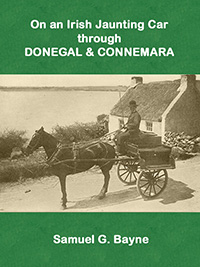
Read On an Irish jaunting Car through Donegal and Connemara at your leisure and help support this free Irish library.
Samuel Gamble Bayne was born in Ramelton, County Donegal, and educated at Queen's University in Belfast. At the age of twenty-five he left for America with a view to making his fortune. He invested in an oil well in Pennsylvania and later founded a bank which subsequently came to be the JP Morgan Chase bank in New York. By the time this book was written he was wealthy enough to be referred to as a billionaire. His account of the tour through the north, west and south of Ireland is a pleasant snapshot of how that part of the country was in the early part of the 20th century. He describes what is to be seen, gives some background history and, through the illustrations especially, provides wonderful glimpses of the area's social history.
The ebook is available in .mobi, .epub, and .pdf formats. See details ».