
McSwine's Gun, County Donegal
One mile to the west in a direct line is "McSwine's Gun," concerning which marvellous fables are told. The coast here is very precipitous and perforated with caverns, one of which, running in for some distance, is connected with the surface above by a narrow orifice, which is very difficult to find without a guide, or very specific directions and the close observance of landmarks. Through this, in rough weather, the sea dashes, throwing up a column of water accompanied by a loud explosion or boom, which is said to have been heard as far as Derry.
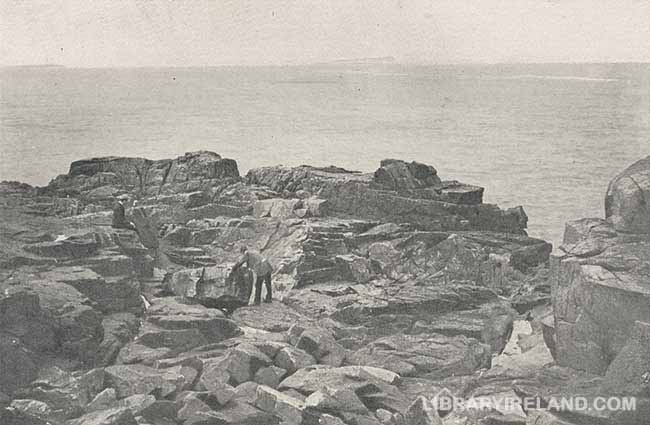
McSwine's Gun, Horn Head, County Donegal
To the south of the rocks lies the fine stretch of Tramore Strand. A little to the northeast of this spot is a circular castle. Continuing by the shore, Pollaguill Bay is reached, joined by cable with Tory Island. As seen from the land, the coast is rocky, broken, and indented, and in about two miles rises into the precipitous mass of Horn Head, over six hundred feet high. This headland somewhat resembles in shape a double horn, bordered on one side by the inlet of Sheephaven, though on the other the coast trends away to the south. The cliffs present a magnificent spectacle of precipitous descents, shelving masses of rock and yawning caverns lashed by the furious waves of the Atlantic. The view from the summit of the head is one of boundless ocean, broken only on the northwest by the islands of Inishbeg, Inishdooey, Inishbofin, and Tory, and on the northeast by the different headlands of this rugged coast — i.e., Melmore, Rinmore, Fanet, Dunaff, and Malin heads, while on the east is seen in the distance the little island of Inishtrahull.
Read "On an Irish Jaunting Car through Donegal and Connemara" at your leisure
Read On an Irish jaunting Car through Donegal and Connemara at your leisure and help support this free Irish library.
Samuel Gamble Bayne was born in Ramelton, County Donegal, and educated at Queen's University in Belfast. At the age of twenty-five he left for America with a view to making his fortune. He invested in an oil well in Pennsylvania and later founded a bank which subsequently came to be the JP Morgan Chase bank in New York. By the time this book was written he was wealthy enough to be referred to as a billionaire. His account of the tour through the north, west and south of Ireland is a pleasant snapshot of how that part of the country was in the early part of the 20th century. He describes what is to be seen, gives some background history and, through the illustrations especially, provides wonderful glimpses of the area's social history.
The ebook is available in .mobi, .epub, and .pdf formats. See details ».