
Cormac's Chapel - Irish Pictures (1888)
From Irish Pictures Drawn with Pen and Pencil (1888) by Richard Lovett
Chapter IV: From Dublin to Cork … continued
« Previous Page | Start of Chapter | Book Contents | Next Page »
Next in order of time, but supreme in historical and architectural interest, comes the unique Chapel of Cormac. This was begun by Cormac MacCarthy, King of Munster, in 1127, and consecrated in 1134 A.D. The entry in the Annals of Inisfallen runs: '1134. The church built by Cormac MacCarthy at Cashel was consecrated by the archbishop and bishops of Munster, at which ceremony the nobility of Ireland, both clergy and laity, were present.'
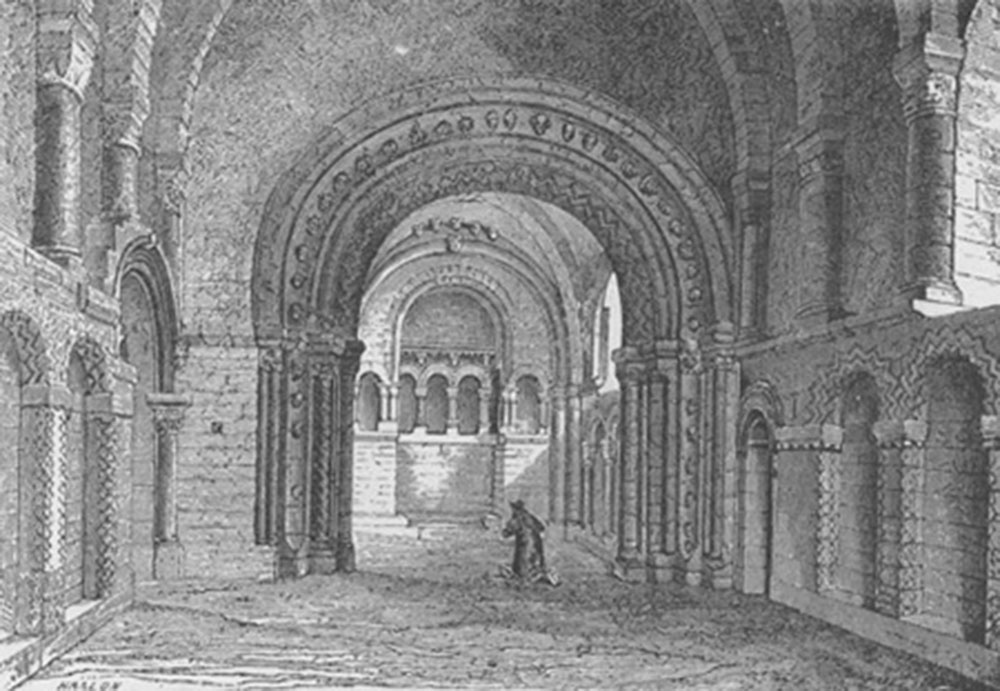
Interior of Cormac's Chapel, Cashel
Notwithstanding its great age, the edifice is in very good preservation, and presents many features of special interest to the student of ecclesiastical architecture. It differs in several respects from the common type. It has no east window in the chancel, and no original west door; it has both a north and south entrance, and at each side of the end of the nave a tower rises, the southern to a height of 55 feet, the northern 50. In the southern tower is a staircase leading to some crofts or apartments situated between the interior stone roof, and the high external vaulted roof; the chancel arch, which is very handsome, and is not placed in the centre, but at the southern side of the dividing wall. The arch is decorated with numerous carved human heads. The whole building is 50 feet long by 18 wide.
The north door, of which we give an engraving, is very richly decorated. It doubtless formed the original main entrance to the chapel. It consists of five concentric arches or mouldings, supported by five columns and a double column. In the archway of the door is a sculpture representing a centaur shooting at a lion, which is tearing some other animal beneath its paws.
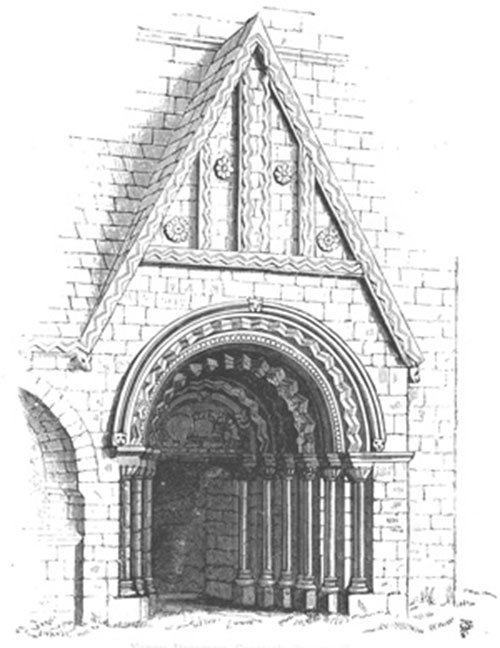
North Doorway of Cormac's Chapel, Cashel
A recess in the north wall holds a tomb said to be that of Cormac MacCarthy; but there is reason to believe that it is later in date, Cormac's tomb having been removed a century or so ago to the north transept of the cathedral close by. The ornamentation on this latter tomb is twelfth century work, and when it was opened many years ago a fine crozier was found in it. This ultimately passed into Dr. Petrie's possession, who after carefully studying the old annals came to the conclusion that Cormac was a bishop as well as a king, and hence that the crozier may be the one used by Cormac himself. The head only has survived, the rest being of perishable material. 'This is formed of copper, and measures 12 inches in length and 5 in the diameter of the crook. Its surface is covered with a sunk lozenge carving, filled with a vitreous enamel of a blue colour, the intervening elevations of which are gilt—a design obviously intended to represent the scales of a reptile. Within the curve is a human figure, standing, with one leg placed on the neck of the serpent, and the other on the back of a double-faced, wingless dragon, which he has pierced in the back with a spear which the dragon bites. This human figure is dressed in a simple tunic, tied round the waist; and the feet are covered with buskins which extend above the ankles. The bowl is encircled by a central belt ornamented with nine turquoises and nine sapphires, placed alternately and at equal distances from each other. Immediately above the bowl is an ornament resembling the Irish crown. The lower part or socket is ornamented with a very graceful pattern composed of leaves or flowers in three vertical ranges, separated from each other by three figures of a fish; the well-known mystical symbol of the early Christians; and these are each ornamented with a range of seven gems, turquoises and sapphires placed alternately at equal distances along the back.'[2]
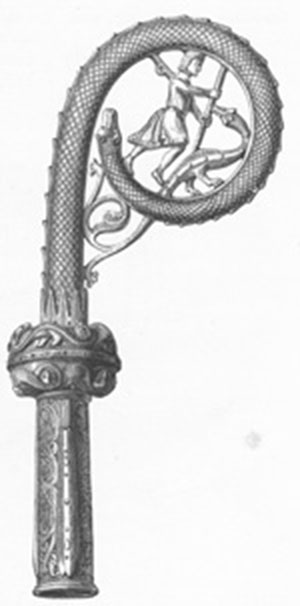
Crozier from Tomb in Cormac's Chapel
« Previous Page | Start of Chapter | Book Contents | Next Page »
NOTES
[2] Round Towers of Ireland, p. 313.