
Cashel - Irish Pictures (1888)
From Irish Pictures Drawn with Pen and Pencil (1888) by Richard Lovett
Chapter IV: From Dublin to Cork … continued
« Previous Page | Start of Chapter | Book Contents | Next Page »
Leaving Kildare and Kilkenny behind, and hastening on towards the west, the Rock of Cashel next deserves attention. Like Kilkenny, only in much higher degree, Cashel combines beauty of situation with a wealth of ancient architectural remains and historical associations. Cashel is a small country town, not specially noteworthy in itself, the houses of which cluster near the base of a mass of limestone rock 300 feet high. This mass of limestone forms the far-famed Rock of Cashel. Rising as it does very abruptly from the broad fertile Golden Vale of Tipperary, it formed a natural fortress, certain to be adapted in warlike times to purposes of defence. Equally certain also was it to become the site of religious buildings. The combination of castle and abbey, of religious and military power, so frequently met with in Ireland, existed here in full force. The ecclesiastical remains are now much more prominent than the military. Comparatively few traces of the ancient fortifications remain, but the eye is almost bewildered by the towers and turrets and arches of the churches; yet the balance is well preserved. The mere appearance of the rock conveys a sense of strength and security, testifying to its ancient power; while there is a fitness, if choice must be made, in the fact that the splendid architectural remains tend to direct the thoughts of the observer from earthly might and splendour towards the kingdom of Heaven and the Prince of Peace. The name reflects the past history of the country, for there were many Cashels scattered over Ireland in ancient days, and the word has long formed part of many proper names. It comes from the Irish caiseal, and signifies a circular stone fort. The rock at this particular Cashel having been in early times the stronghold of the kings of Munster, and having pre-eminent natural advantages, has in the course of time appropriated the generic as its own specific name.
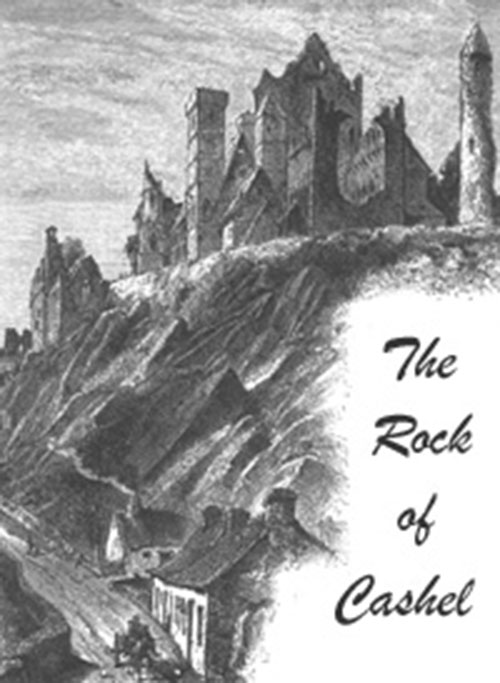
Rock of Cashel
The earliest historical references to Cashel describe it as the regal fortress of the kings of Munster. St. Patrick, according to the life in the Book of Armagh, visited Cashel, and converted the king. 'After this Patrick went into the province of Munster, to Cashel of the Kings. When Oengus, son of Natfraich, arose in the morning, all the idols were on their faces; and Patrick, with his household, found him beside the fort. He gave them welcome and brought them into the fort to the place where Patrick's flagstone is to-day. And after this Patrick baptized Natfraich's sons, and left blessing and prosperity upon them; and blessed the fort, namely Cashel, and said that until Doom only one slaughter should take place there. And he abode seven years in Munster.
'While Patrick was baptizing Oengus, the spike of the crozier went through Oengus's foot. Said Patrick, "Why didst thou not tell this to me?" "It seemed to me," saith Oengus, "that it was a rite of the faith." "Thou shalt have its reward," said Patrick: "thy successor," that is, the seed of Oengus and Ailill, son of Natfraich, "shall not die of a wound from to-day for ever." No one is King of Cashel until Patrick instals him, and confers ecclesiastical rank upon him; and twenty-seven kings of the race of Ailill and Oengus ruled in Cashel under a crosier until the time of Cenn-gecan (slain A.D. 897).'[1]
In 1101, according to the Annals of the Four Masters, a convocation of the people of the southern half of Ireland was held at Cashel, at which Murtough O'Brien, the king, gave Cashel to the devout, 'for the use of the religious in Ireland in general.' Murtough's successor, Cormac, built the famous chapel in 1134. In 1152 Cashel became the seat of the archbishopric of Munster, and soon after a cathedral was built. Henry II. here received the homage of Donnell O'Brien, King of Munster; Edward Bruce held a parliament here; in 1495 Gerald, Earl of Kildare, burnt the cathedral, because he thought the archbishop was inside. He was grieved afterwards to learn that his supposition was incorrect.
The chief buildings upon the Rock of Cashel are the round tower, Cormac's Chapel, and the ruined cathedral. The cluster of towers, arches and walls presents a most effective appearance as the traveller approaches the rock on his jaunting car. The round tower stands at the north-east corner of the north transept of the cathedral, is 90 feet high, 50 feet in circumference, and has walls 4 feet thick. It was divided into five stories or floors, and the masonry is said to be as good as that of the White Tower in the Tower of London. The original conical roof is still upon it. Although not specially- mentioned in any of the Irish annals, there can be but little doubt that this is the most ancient of all the buildings now standing upon the rock.
« Previous Page | Start of Chapter | Book Contents | Next Page »
NOTES
[1] Tripartite Life of St. Patrick, vol. i., pp. 195, 197.