Book of Armagh - Irish Pictures (1888)
From Irish Pictures Drawn with Pen and Pencil (1888) by Richard Lovett
Chapter 1: Ireland’s Eye … continued
« Previous Page | Start of Chapter | Book Contents | Next Page »
The third and in some respects the most interesting of all is the Book of Armagh, a curious composite volume of very great importance in the literary history of Ireland, and in regard to the life of St. Patrick.
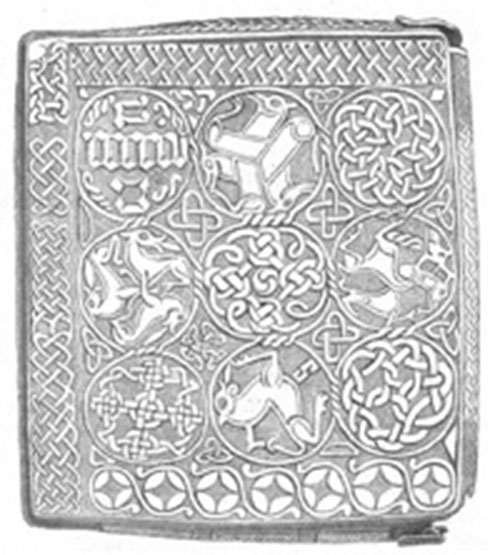
Leather Outer Case of the Book of Armagh
Dr. Reeves has discovered evidence in the MS. itself that renders it almost certain that it was written about A.D. 807 by a scribe named Ferdomnach. It seems to have been referred to by the Annalists as 'the Canon of Patrick,' and they record that in 937 it was enclosed in a case by Donogh, the son of Flann, King of Ireland. At a later stage the ancient silver case was enclosed in a leather cover, and of this we are able to give an illustration. It presents a typical example of Irish ornamentation. An entry at the foot of folio 16 purports to have been made in the presence of the far-famed Brian Boru. In that case it was most probably done in 1002, when that king offered twenty ounces of gold on the altar of Armagh. In ancient days, according to the usual custom, the book had a maor or keeper, who received an endowment of land in virtue of his office. His descendants were known as Meic maor, 'sons of the keeper,' and in time this became Mac Moyre. Upon the reverse of one leaf appears, under the date of 1662, the signature of Florentinus Moyre, the last of the family who held the guardianship of the book. This man went in 1680 to London to give evidence in a trial, and, before starting, placed the book in pledge for five pounds. Soon after, the MS. and its leather case came into the hands of Arthur Brownlow; it remained in the Brownlow family until 1853, when Dr. Reeves purchased it, and handed it over to the late Primate Beresford, who in his turn presented it to the Library.
'The Book of Armagh is now defective at the commencement. Its first surviving portion is occupied with notes in Latin and Irish on St. Patrick's acts, a collection styled Liber Angueli, relating to the rights and prerogatives of the See of Armagh, and the Confession of St. Patrick. These are followed by St. Jerome's letter to Damasus, Eusebian Canons, and preface to the New Testament; interpretation of Hebrew names; Gospels of Matthew, Mark, Luke, John; Epistles of Paul, including that to the Laodiceans, with prefaces, chiefly by Pelagius; Acts of Apostles; and Life of St. Martin of Tours by Sulpicius Severus. Some of the pages are much rubbed, as if frequently exposed or touched, probably for the purpose of swearing.'[6]
There are very interesting specimens to be seen here of other classes of MSS. Standing highest in general interest are those belonging to the Greek Testament. The Library possesses a valuable palimpsest, known as the Codex Rescriptus Dublinensis; it has been carefully edited by the present librarian, the Rev. T. K. Abbott. It is a small quarto volume, 8½ inches by 6, consisting of no folios. It contains considerable portions of St. Matthew's Gospel, and its readings possess a very high critical value. It dates in all probability from the fifth century, and is known in the lists of authorities by the letter Z. Any one who wishes to appreciate Dr. Abbott's labours, and the enormous difficulty of much of the work done on behalf of recent New Testament scholarship by such men as Tischendorf and Tregelles, should inspect this MS. They will find it extremely difficult even to see, to say nothing of deciphering, the dim Greek uncial letters that were nearly obliterated many centuries ago, to make way for the later and less valuable writing placed over it.
The Library also possesses a much later MS. that has been rendered famous by a fortuitous event in Greek Testament controversy. It is well known that Erasmus omitted from the first edition of his Greek Testament the words in 1 John v. 7, 8, translated in our A.V., 'In heaven, the Father, the Word, and the Holy Ghost: and these three are one. And there are three that bear witness in earth.' When attacked for so doing, he promised that if a single Greek MS. could be found containing the words he would then insert them. They were at last found in a Greek MS., written in the cursive or running hand, of late date and very doubtful authority. This MS., known as the Codex Monfortianus, is also carefully kept in the Manuscript Room. Erasmus, true to his promise, although he did not believe the words to be genuine, inserted them in his third edition. The Revised Version omits them, as resting upon altogether insufficient authority.
But it is high time we left the Library for a stroll through the College itself.
The various departments of learning are all adequately housed within its very extensive precincts; the medical school being especially fortunate in this respect. The chemical lecture room and laboratory are splendidly equipped with all the latest and best facilities both for lecturing and practical work. The college park is also a very pleasant place of resort, and on the occasion of a University Cricket Match or Athletic Sports is thronged with the fashion and beauty of Dublin.
Across the street, and opposite to the north-west corner of Trinity College, stands the considerable pile of building in which centres the work of the Bank of Ireland. Formerly the Irish Houses of Parliament met here. Visitors are still shown the room in which the Irish House of Lords met, and which, one is told, remains very much now as it appeared in the days of Castlereagh.
NOTES
[6] National MSS. of Ireland, p. 23.
« Previous Page | Start of Chapter | Book Contents | Next Page »